
Stan Getz
February 2, 1927 – June 6, 1991
| Instrument | Tenor Sax |
| Birthplace | Philadelphia PA |
Available Leadsheets
- Battle Of The Saxes - Al Cohn Swing (medium up)
- Battleground - Al Cohn Swing (medium up)
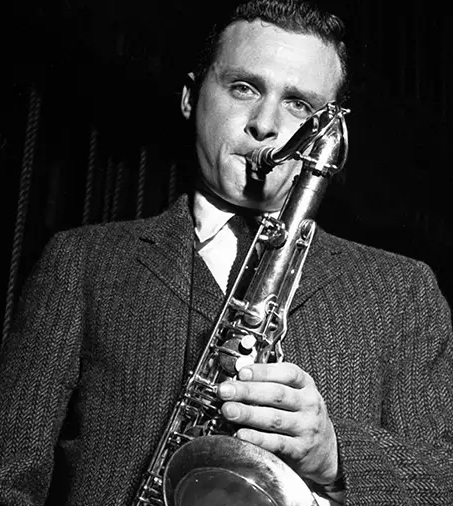
Throughout a long and varied career, Stan Getz was one of the most revered tenor saxophonists in all of jazz history and remains one of the best-known to this day. He lent his airy, mellow tone and lyrical melodic style to a vast range of styles over nearly 50 years. Like most tenor saxophonists associated with the ‘40s-50s “cool school,” he initially took much inspiration from Lester Young; Getz did as much as anyone to modernize and adapt Young’s influence into his own unique sound.
Born in Philadelphia and raised in New York, Getz began his career at age 16 when he joined the big band of trombonist Jack Teagarden. Touring with this band brought Getz to Los Angeles, where he settled and played first in Stan Kenton’s big band, then with Benny Goodman. Back in New York while still in Goodman’s band, Getz recorded his first session as a leader in July 1946; on this recording he displays a powerful, bebop-infused sound very different from his later style. The following year, he joined Woody Herman’s big band. His solos with Herman, such as on Ralph Burns’ Early Autumn and Jimmy Giuffre’s Four Brothers (alongside fellow tenor saxophonists Zoot Sims and Herbie Steward and baritone saxophonist Serge Chaloff) brought him widespread recognition as an early “cool school” player. Getz left Herman’s band in 1950 to continue his career mostly as a freelance leader of small groups.
From 1958 to 1961, Getz lived in Copenhagen, Denmark. Upon returning to the US, he recorded “Focus,” a unique “third stream” album featuring a chamber ensemble arranged by Eddie Sauter. The following year, he joined guitarist Charlie Byrd to record “Jazz Samba,” perhaps his most famous album, which introduced Brazilian bossa nova to the American audience. Over the next few years he continued to play and record Brazilian music, with “Getz/Gilberto,” his collaboration with Joao Gilberto, Astrud Gilberto and Antonio Carlos Jobim, winning two Grammys. Getz also recorded “Big Band Bossa Nova” featuring arrangements by Gary McFarland. Throughout the 1950s and '60s, Getz also collaborated with Bob Brookmeyer.
As a leader, Getz helped to launch the careers of many legendary musicians from the ‘50s through the ‘80s, including Horace Silver, Jimmy Raney, Chick Corea, Gary Burton and Victor Lewis.