
Allen Eager
January 10, 1927 – April 13, 2003
| Instrument | Tenor Sax |
| Birthplace | New York NY |
Available Leadsheets
- Battle Of The Saxes - Al Cohn Swing (medium up)
- Battleground - Al Cohn Swing (medium up)
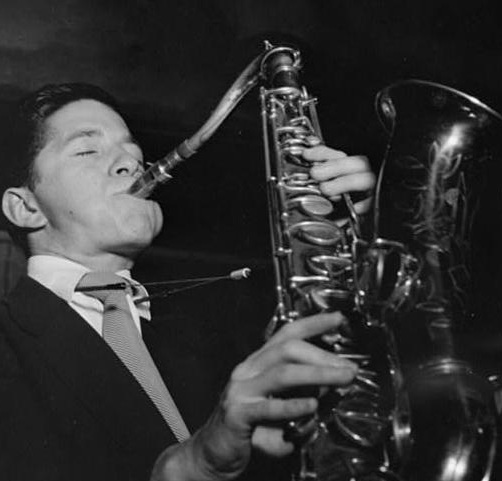
Allen Eager had certainly one of the more unusual lives in jazz history. Like fellow saxophonists Don Lanphere and J.R. Monterose, Eager had a promising start to his career followed by years away from the “scene” —but in this case with several striking diversions. His upbringing in New York put him right at the birthplace of bebop in the 1940s. After playing with several big bands in his teens including Woody Herman’s, Eager made his first recording as a leader in 1946 at age 19. Even by then, his light-toned, smooth style, indebted equally to Lester Young and Charlie Parker, marked him as one of the pioneers of the cool jazz sound. Eager continued to play with many of the bebop elite through the ‘40s-50s, notably in Tadd Dameron’s quintet; there are live broadcasts of Eager alongside Charlie Parker and Miles Davis though he never made studio recordings with them. After living in Paris in 1956-57, Eager’s last recording from the ‘50s was on Gerry Mulligan’s “Songbook, Vol. 1” also featuring Lee Konitz, Al Cohn, and Zoot Sims.
Eager spent the next few years as a ski instructor in the Catskills, but returned to music briefly in 1960; he played at a festival organized by Charles Mingus and Max Roach in protest against the increasingly commercial Newport Jazz Festival. Soon after this, Eager got into sports car racing; he would go on to settle in Florida and spent most of the ‘60s and '70s away from music. He finally started performing again in the ‘80s, recording an album titled “Renaissance” in 1982. Later in this decade he toured with Dizzy Gillespie and Chet Baker. Eager’s last recording, in 1986, was on “Taking Sides” by fellow tenor saxophonist Phil Urso, also featuring pianist Eddie Higgins.